Showing posts with label Vitamin D. Show all posts

Monday, October 7, 2013

More Salt Equals More Multiple Sclerosis


This was a recent abstract (not formally published yet) which I found interesting. It was only a small study but showed a NEGATIVE TREND between increased salt intake and increased Multiple Sclerosis manifestations, both in terms of clinical events, like MS exacerbations, and in terms of new lesions on the MRI. Yikes.
The magic number was more than 4.8 grams a day. Once that number was reached, MS event relapse rates were 4 times higher than those who had less than 2 grams a day. Obviously, what to say about the in-between range is a grey area.

That being said the causal relationship is harder to prove. In other words, HOW this would be true is harder to determine and therefore the fundamental truth that salt itself is responsible also has to be further questioned. Other possibilities: Maybe people with worse, more aggressive MS are hungrier for more salt for some reason.

Theories on how salt would cause this are unclear. Many argue that salt causes and increased inflammatory condition in the human body or increased oxidative stress indirectly in the human body. It also may increase the permeability of the blood brain barrier which keeps the brain "locked off" from the body. This increased permeability would make it easier for the person to mistakenly "accidentally remember" that the myelin around the brain and spinal cord neurons is not part of you (of course, it is) and attack it again, inappropriately.

Interestingly a Big Mac alone contains almost 1gram. 
 versus
A cup of broccoli (29mg), a cup of grapes, a pre-made-pre-cooked chicken cordon blue (490 mg), an Oikos greek Yogurt (100mg) and a cup of milk chocolate Blue Bell ice cream (100mg).... is still only 719 mg of sodium.

I have included the full reader-friendly article below, and put a bold on my favorite part:
--------------------------------------------------------------------------------------------


COPENHAGEN -- Sodium intake was positively correlated with risk of increased disease activity in patients with multiple sclerosis, according to a small study reported here.
Each gram of estimated daily sodium intake above the average in a 52-patient sample was associated with an increase of 3.65 in MRI lesion counts, said Mauricio Farez, MD, PhD, of Buenos Aires.
Also, patients with estimated salt intake classified as high -- more than 4.8 g daily -- showed relapse rates that were 3.95 times greater (95% CI 1.39-11.21) than those with intakes less than 2 g/day, he told attendees at the European Committee for Treatment and Research in Multiple Sclerosis annual meeting.
Farez emphasized repeatedly that the findings did not prove that high salt intake caused the increased disease activity. He acknowledged that, if there is a causal relationship, it possibly could go in the reverse direction -- that patients with highly active MS may increase their salt intake as a result. But he said he did not view that as very likely.
The study in a total of 122 patients with relapsing-remitting MS grew out of previous research connecting salt intake with vitamin D levels and body mass index, he said. Numerous studies have indicated an association between vitamin D status and MS risk.
He and colleagues initially recruited 70 patients for a first phase of the observational study. They underwent a baseline MRI scan in November 2010, followed by MRI scans and analysis of urinary sodium excretion as a means of estimating sodium intake 1 year later. Finally, in November 2013, relapse rates for the preceding 2 years were calculated.
During this first phase, the MRI analyses included "combined unique activity" counts -- the total of new T2 lesions and new gadolinium-enhancing T1 lesions since the baseline scan.
A second group of 52 patients was examined in June 2013 with MRI scans and urinary sodium testing to provide replication data for the association between sodium intake and MRI lesion activity. Because this group had only a single scan and no follow-up, Farez and colleagues could only calculate T2 lesion loads, not the combined unique activity lesion counts nor relapse rates.
Farez acknowledged that an important limitation of the study was that it did not measure urinary sodium excretion with 24-hour urine collections, which he said were impractical since they require participants to carry a large container to capture all their urine for a whole day and night.
Instead, his team relied on spot urine collections and a published formula to estimate daily sodium excretion and, from that, daily sodium intake.
He reported that, in the first group of patients, not only those with high sodium intake (more than 4.8 g/day) but also those with "average" consumption showed increased risk of relapse. Participants with estimated daily intake of 2.0 to 4.8 g/day had relapse rates that were 2.75 times that of the low-intake group (95% CI 1.30-5.81).
Comparing both the average- and high-intake groups, the trend was significant at P=0.001, he reported.
Also in the first group, combined unique activity lesion counts were approximately three times greater in both the average- and high-intake groups compared with the low-intake group (P not reported), Farez said.
And, T2 lesion counts were similar in the first cohort's low- and average-intake groups at an average of about 6, but they reached a mean of approximately 14 in the high-intake group (P<0.05).

In the replication set of 52 patients, similar results were seen, Farez said. He and his colleagues calculated that each increment in intake of 1 g above the cohort average was associated with 3.65-lesion increase in T2 count (SD 0.77, P<0.001).

He did not specify the cohort average, but he said that the national average in Argentina has been measured at nearly 5 g/day, well above the U.S. mean of 3.4 g/day.

The World Health Organization has recommended a maximum daily intake of 2 g/day. In the U.S., several government agencies have jointly called for a maximum of 1.5 g/day-- but earlier this year, the Institute of Medicine complained that the scientific evidence did not a support such a low figure, instead backing an older standard of 2.3 g/day.

Farez and colleagues also measured serum sodium but found no relationship between it and clinical or MRI activity. It was also not significantly associated with estimated sodium intake, with an R2 value of just 0.0082.
Asked by the session moderator what a causal mechanism might be, Farez said previous studies had suggested that high salt levels can promote increased inflammatory activity throughout the body. Also, he said, it may increase permeability in the blood-brain barrier, which could contribute to inflammation in the central nervous system.
Whatever such a mechanism may be, he said, "it does not seem to occur in peripheral blood."

Vitamin D and Multiple Sclerosis: Low serum levels = MORE disease and MORE severity of disease


This recent abstract at a large Multiple Sclerosis meeting confirms what neurologists already know, but underlines it quite well: There is something going on between Vitamin D levels and both the diagnosis of Multiple Sclerosis and the progression of it. This study just helped support the concern that lower levels in the bloodstream, versus higher levels, meant more disability from the disease.

This study essentially compared normal levels of Vitamin D versus sub-par levels in the blood. All the normal level patients did better than those that ran low.

I have all my patients with MS take Vitamin D supplements of 4000 I.U. daily at a minimum and many at 10,000 I.U. daily. I would rather patients be on the higher end of the spectrum.

I starred my favorite line below, toward the end. 

I saw the original abstract which is quite tedious and boring-looking. Here's the more digestible story summary in greater detail below:
--------------------------------------------------------------------------------------------

COPENHAGEN -- Higher levels of 25-hydroxyvitamin D correlate with less Multiple Sclerosis disease activity and progression, researchers reported .
Every 50 nmol/L increment in average serum 25-hydroxyvitamin D levels observed at baseline translated into a 57% lower rate of new active multiple sclerosis-defining lesions (P=0.0009), reported Alberto Ascherio, MD, MPH, professor of medicine at Brigham & Women's Hospital and Harvard Medical School.
In his oral platform presentation at the annual meeting of theEuropean Committee for Treatment and Research in Multiple Sclerosis, Ascherio also found that higher baseline differences in 25-hydroxyvitamin D levels were associated with:
  • A 57% lower relapse rate (P=0.03).
  • A 25% lower increase in T2 lesion volume (P=0.00004).
  • A 0.41% lower yearly loss in brain volume (P=0.07) from 12 to 60 months.
  • Fewer active lesions at MRI (Hazard ratio 0.73, P=0.002).
  • A lower increase in T2 lesion volume (difference = - 9% per year, P=0.008).
  • A lower rate of brain loss (0.32% versus 0.66% per year, P=0.005)
  • Lower disability demonstrated by a -.17-point reduction in the Expanded Disability Status Scale score (P=0.004) during the subsequent 4 years.
Ascherio said he was unable to determine from his dataset if the lower levels of 25-hydroxyvitamin D were due to the person's lifestyle or to the disease, which influences lifestyle choice.
However, the findings were compelling to session moderator Eva Havrdova, MD, professor of neurology at Charles University in Prague. She told MedPage Today, "The 'normal' level of Vitamin D he was talking about in his study is what is needed to prevent rickets. It is not a very high level of Vitamin D. I think supplements of Vitamin D to increase Vitamin D levels up to 100 nmol/L level would be worthwhile, and maybe you would see improvements in the health status of our patients."
For his study, Ascherio and colleagues scrutinized the patient records of those who participated in the BENEFIT study, which compared treating people with clinically isolated syndrome (CIS) either early in the course of the trial or later on. As part of the trial, researchers collected data of baseline 25-hydroxyvitamin D, a marker of vitamin D levels. Levels of 25-hydroxyvitamin D were tracked for a year. Ascherio and his research team then tracked how levels of vitamin D correlated with multiple sclerosis outcomes.
The comparisons in the study were made between those patients whose yearly average level of 25-hydroxyvitamin D was 50 nmol/L or greater and those with lower levels of 25-hydroxyvitamin D. The researchers also broke down the participants in quintiles to further elucidate how differences in 25-hydroxyvitamin D affected patient outcomes. The analyses were adjusted for sex, age, initial randomization group -- treatment with interferon beta-1b or placebo, baseline T2 lesion scores and type of CIS.
The study population included 251 patients with 25-hydroxyvitamin D levels below 50 nmol/L, and 213 patients with multiple sclerosis who had a higher level of 25-hydroxyvitamin D. The median level for the low 25-hydroxyvitamin D group was 39 nmol/L; the median for the higher 25-hydroxyvitamin D group was 60 nmol/L.
The subjects in the study were about 31 years of age; more than 70% were women. At baseline, the low 25-hydroxyvitamin D level patients had a median of 20 T2 lesions compared with 15 lesions in those with higher levels of 25-hydroxyvitamin D.
**********************************************************************************
"Higher serum 25-hydroxyvitamin D levels early in the course of multiple sclerosis robustly predicted a lower degree of multiple sclerosis activity, MRI lesion load, brain atrophy, and clinical progression over 5 years," Ascherio said.
**********************************************************************************
The study, however, leaves many unanswered questions, he said. "Further investigations are needed to determine whether results apply to patients of different races, those later in the disease course, those with progressive multiple sclerosis, or to the effects of 25-hydroxyvitamin D in combination with other drugs aside from interferon beta-1b," he added.

Wednesday, March 7, 2012

Some Newer Data on Multiple Sclerosis Management (Interferon, Tysabri, Vitamin D, Pain)


The below is a review of select data presented at the recent
5th Joint Triennial Congress of the European and Americas Committees for Treatment and Research in Multiple Sclerosis... also known as ECTRIMS.

And so I wanted to share it with you because I thought it had some fantastic nuggets of good information for my patients with MS.

As you look this over, be patient with me. No one likes unwieldy graphs, but these are pretty straight forward and they are summarized as well. But I think that if you or your loved one have MS, I believe it's reasonable for me to expect you to gather the patience to wade through some graphs created for you.

ECTRIMS this year had a number of presentations looking at how to optimize our currently existing disease-modifying therapies, treatments for acute relapses, and symptom management. Although a lot of attention is paid towards the future therapies, I think maximizing what we have available to us today is crucial.


The REFLEX trial is a study of two administration schedules of interferon β-1a at 44 μg (commonly known as Avonex or Rebif, although they are meant to represent any of the interferons). This is a clinically isolated syndrome trial (just one attack of demyelination, before the actual official diagnosis of MS), so a trial of this drug after the first attack of demyelinating disease, and this is a three-arm (3 separate groups) study of 44 μg given subcutaneously three times a week versus only once a week versus placebo (no active medication) injections.

The main purpose of this is really to establish the efficacy in clinically isolated syndrome (to see if works at helping prevent a one-time event from actually turning into MS).

A secondary purpose of this trial is to demonstrate the efficacy of three-times-a-week interferon—the high-dose, high-frequency strategy of interferon use—over a less frequently dosed schedule (if more of the medication within reason, better).


The outcomes of this looked at the development of MS by the McDonald criteria, which has become the standard way of looking at diagnostic certainty for multiple sclerosis (especially for all research studies to make the diagnosis is uniform across the planet). I should add that they used the McDonald 2005 criteria, as opposed to the more recently developed 2010 criteria; this trial was run well before that most recent criteria was produced (although the new criteria isn't too significantly different).

The primary outcome data showed that with NO TREATMENT (placebo medication) the median time to convert to McDonald MS was 97 days (about 3 months).

On interferon 44 μg given once a week, it was 182 days (half a year).

And, on interferon β[-1a] 44 μg given three times a week, it was 310 days (2 months shy of a year).

This shows a reduction in the risk of conversion to MS of 31% in the weekly interferon dose (a third less likely) and 51% in the three-times-a-week interferon dose (half as likely).

This outcome is important for a couple of reasons. One, it further provides confirmatory evidence that interferon β-1a is a viable treatment strategy after a first attack, or the CIS, versus placebo. I think it also provides support for the three-times-a-week dosing schedule versus weekly interferon [β]-1a.


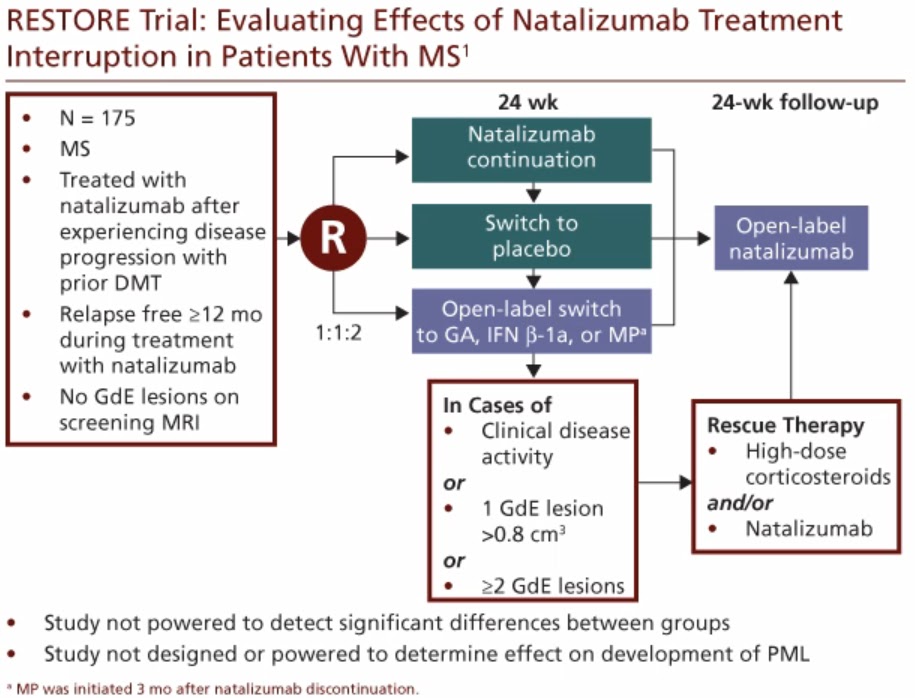
The RESTORE trial was seeking to evaluate the effect of natalizumab (Tysabri) treatment interruption on the clinical course of patients with MS (In other words, what happens if we stop Tysabri due to health concerns?)

In short, there has been a lot of consternation in our field in the past couple of years about how long to keep patients on natalizumab, what with the recognition of the increasing risk of the awful PML with increasing duration of exposure to the drug (The longer you're on the medication, the more likely you are to get PML). This trial was done specifically to look at what are the risks of discontinuation of natalizumab to sort of counterbalance the concerns about the risks inherent in continuing a patient on natalizumab (getting PML as a risk of continuing versus return of MS by stopping).

So this trial looked at patients who'd been on natalizumab and have it discontinued, followed by placebo infusions (fake medication), and then a series of open-label rescue therapies (any interferon or other real medication used to treat MS) to see if disease activity recurred. Disease activity here was described as both clinical activity—changes in EDSS [EDSS: Expanded Disability Status Scale] scores—or MRI disease activity, consisting of new gadolinium (contrast)-enhancing lesions.


In brief, what this study ultimately showed is that stopping natalizumab confers an increased risk of the return of disease activity in multiple sclerosis. There were a substantial number of relapses and an even more substantial number of MRIs showing the resurgence of disease activity in the weeks and months that followed natalizumab cessation. In particular, the highest rate of recurrence of disease activity seemed to appear at around week 12, after natalizumab was discontinued.

This provides some supportive data to the notion that stopping natalizumab therapy brings about a somewhat riskier period of time for MS patients when disease activity may return.

It does not answer the question as to how to treat these patients after natalizumab is stopped, nor does it provide specific guidance in regards to which patients should be maintained on natalizumab for a longer period of time. But I do think it provides some supportive evidence to know that patients in whom natalizumab has been stopped, for whatever reason, need to be observed closely and likely treated promptly with other disease-modifying therapies (Avonex, Rebif, Betaseron, Copaxone, Gilenya, etc...) to prevent the recurrence of their MS.

The vitamin D story in multiple sclerosis has evolved rapidly over the last several years. It has long been recognized that there is a latitudinal gradient to the incidence of MS with higher incidence seen further from the equator.


The role of direct sunlight and, therefore, natural generation of vitamin D being more prevalent near the equator has been one hypothesis for this difference in the incidence of MS.
Subsequently, epidemiologic studies of patients have shown that there may be a correlation between chronically low vitamin D states and the development of multiple sclerosis in otherwise more homogenous populations. Due to this, a lot of attention has been turned to vitamin D to see whether it, in fact, correlates with the development of MS and the severity of MS, and whether, perhaps, treating with supplements of vitamin D can be disease modifying.


Studies presented at ECTRIMS looked at the effects of endogenous and supplemental vitamin D in patients with MS. And they found that, for every 10-ng/mL increase in vitamin D levels, there is a significant reduction in the risk of new gadolinium-enhancing or T2 lesions (32% decreased risk and 15% decreased risk for these different "flavors" of MRI imaging).

Supplemental vitamin D3 decreased gadolinium-enhancing lesions. I think this study continues to further the notion that there is a meaningful relationship between vitamin D levels and MS disease outcomes. And certainly provides some tantalizing evidence that supplementing vitamin D may allow us another angle to change the disease course. There is going to be larger and ongoing studies of vitamin D supplementation, trying to evaluate this in a larger population with clinical outcomes. That work is ongoing.


Turning to symptom management in multiple sclerosis, pain is a very commonly reported symptom of MS, and many studies have shown that it has significant impacts on quality of life in people with multiple sclerosis.
This study looked at the use of duloxetine (Cymbalta) in the treatment of central neuropathic pain in MS patients. And the study was positive and showed a greater improvement in the pain index scores for duloxetine versus placebo-assigned patients, although there was a significant placebo effect on pain. But duloxetine did have better outcomes in a statistically significant way than placebo at controlling central neuropathic pain in the patients studied here.
This trial provides information that duloxetine and this class of medicines may very well have a role for pain management in multiple sclerosis. As we have seen, other comorbidities and related symptoms in MS that are very common include depression and anxiety. And, although these things weren't studied as outcomes in this trial, the utilization of a medicine that may also help to treat depression and anxiety, as well as pain symptoms, may be a very useful strategy in a number of MS patients with several MS-related quality-of-life symptoms.


Before we fully turn our attention to the emerging therapies on the horizon, it's important to think about maximizing the efficacy and outcomes of our currently existing therapies across the needs of MS patients.
We also have to carefully balance the benefit-to-risk ratio of our medicines in the long-term for MS patients. A lot of attention has been turned to the risks of our medicines, such as the risk of PML with natalizumab. The trial we discussed talks a bit about the other side of that risk equation: What are the risks inherent in MS when a treatment like natalizumab (Tysabri) is discontinued? Showing there that stopping natalizumab therapy does seem to result in a high rate of recurrence within the first 12 weeks after the treatment is stopped.
And the vitamin D story continues to evolve with data now suggesting that not only are lower levels of vitamin D related to higher levels of MS disease activity, as shown on MRI, but, in fact, treating with supplementary vitamin D may exert a significant protective effect in this regard.
Finally, looking at symptom management, duloxetine (Cymbalta) appears to be a viable management option to treat central pain syndromes that are so often seen in multiple sclerosis.