Showing posts with label Sleep Apnea. Show all posts

Wednesday, December 21, 2011

Sleep Disorders Common Among Police Officers


Below, I have summarized a study from the December issue of JAMA (Journal of the American Medical Association), arguably the most respected medical journal in the world. At the very bottom is a pdf of the entire JAMA article.

In the study below which you can read more about (wish you would) if my summary is not enough to satiate your curiosity, this group decided to look a large sample of police officers as important guardians of the law that supports our society, and see if they have sleep disorders and if so, is their ability to serve that roll compromised? For me, the answer of affects on their health is already glaringly office based on general population effects well established, of which I refer to in other teaching blogs and will bore your ear off in my office as much as you want.

So they looked at large number (almost 5,000 (4,957 to be exact)) of police officers between the summer of 2005 and winter of 2007, screening them by online surveys or on-job-site surveys for sleep disorders of all types.

Almost HALF (40%) screened positive for at least one sleep disorder which suggests almost half of ALL police officers have something compromising their quality of sleep.

If you break that number down, 33.6% had obstructive sleep apnea, 6.5% moderate to severe insomnia, and 5.4% had shift work disorder.

In other words, 1/3rd of ALL police officers have obstructive sleep apnea according this screening evaluation.

Of these police officers with a sleep disorder, they were more than two times MORE likely to be depressed. They also were significantly more likely to have diabetes, cardiovascular disease, dose themselves with high caffeine intake.

Of ALL cops, 28.5% complained of being excessively sleepy, and an astounding 26% reported falling asleep while driving at least once or twice a month!

In the administrative work done by police officers (paperwork is a universal burden it seems- waste of their time if you ask me but I digress), they were also much more likely to make a "serious" administrative error if they had a sleep disorder.

If they had a sleep disorder, they were also significantly more likely to have "uncontrolled" anger toward suspects, absenteeism from work responsibilities, fall asleep during meetings.

I have a growing number of police officers in my sleep practice, with very legitimate sleep concerns, and I hope this becomes an eyeopener to police departments on behalf of their officers.
------------------------------------------------------------------------------------------------------------------

If you want to read the actual JAMA article in detail, click on this link (for the whole thing):


________________________________________________________________________________

Thursday, December 15, 2011

CPAP Makes You Thinner?


What is metabolic syndrome?
It depends (only slightly) on who you ask.
In this study, they followed the criteria created by the National Cholesterol Education Program which is the following:
-- A large waist: A man's waist larger around than 40 inches (102 cm) or a woman's waist later around than 35 inches (88cm).
--Triglycerides greater than 150 mg/dl or needing a medication to treat high cholesterol
--Decreased good cholesterol (HDL) less than 40mg/dl if you're a man and less than 50mg/dl if you're a woman or, again, needing some medication to bring it up.
--High blood pressure greater than 130 systolic (top number) over 85 diastolic (bottom number), or needing a medication to treat a history of high blood pressure.
--High blood sugar greater than 100mg/dl while fasting or needing a medication to treat high sugar

Who cares if I have metabolic syndrome?
You should.
You're much more likely to die from a stroke or heart attack, or be severely crippled by either, if you have it and don't try to do something about it.

Summary of the study:
--They took 86 patients (final number) who had metabolic syndrome as defined above AND who also had sleep apnea.
--Their apnea was anything greater than 5 respiratory events per hour (choking episodes). 5 or less is considered normal for people.
--So in this study, they included anyone who was sleep and had mild apnea or worse. Just so you know, mild apnea is actually pretty common. I see 20, 30, 40, 50 events per hour on sleep studies all the time, which is moderate and severe apnea.
--They divided these people into two groups; some got CPAP therapy at home to fix their apnea, and half got a fake mask treatment so their apnea continued.
--They followed them for three months to see what happened.
--In the group treated with FAKE treatment, NOTHING improved
--In the group treated with CPAP, the following GOT SIGNIFICANTLY BETTER: systolic blood pressure, diastolic blood pressure, blood sugar, total cholesterol, "good" cholesterol, "bad" cholesterol, triglycerides... almost everything essentially. The only thing that didn't get better in the 3 month trial was waist circumference, but what can you really expect in only three months?.... well, a lot it seems.
--The people who used CPAP more during the night had better improvement in their numbers
--Lastly, just to double-check, at the end of the study, they switched the groups, treating the fake CPAP group now with REAL CPAP and treating the prior REAL CPAP group with the fake CPAP and watched all the things above follow the same trend of improvement (if treated with CPAP again for another three months)


Oh, and 13% of the people with metabolic syndrome... NO LONGER HAD METABOLIC SYNDROME AT THE END OF THREE MONTHS with the only change being using CPAP to resolve their apnea.

Read the longer version below if you would like:
------------------------------------------------------------------------------------------------------------------------------------------------------------------------------------------------------------------------------------------------------
CPAP Improves Metabolic Syndrome in Apnea Patients

Blood pressure and metabolic abnormalities improved significantly in patients with obstructive sleep apnea treated with continuous positive airway pressure (CPAP), results of a randomized, crossover trial showed.
Systolic and diastolic blood pressure, lipids, and glycated hemoglobin all responded favorably to three months of CPAP as compared with sham CPAP (P=0.02 to P<0.001).
By the end of the study, 13% of patients treated with CPAP no longer met diagnostic criteria for metabolic syndrome, compared with 1% of patients in the sham-CPAP control group, as reported in the Dec. 15 issue of the New England Journal of Medicine.
"CPAP is the first-line treatment for moderately severe obstructive sleep apnea and may be useful for treating the metabolic syndrome or metabolic abnormalities associated with obstructive sleep apnea," Surendra K. Sharma, MD, PhD, of the All India Institute of Medical Sciences in New Delhi, and co-authors wrote in the discussion of their findings.
"As compared with patients in other studies, our patients had more severe metabolic derangements at baseline, which could be one reason for the better response to CPAP therapy," they added.
CPAP was also associated with significant weight loss, which might have contributed to improvement in metabolic parameters.
Estimates of obstructive sleep apnea prevalence have ranged as high as 24% for men and 9% for women. The sleep disorder frequently is associated with metabolic syndrome, with estimates as high as 85% of patients with obstructive apnea and 41% of patients with nonobstructive apnea, according to the article's background information.
CPAP is first-line therapy for symptomatic obstructive sleep apnea and has demonstrated high rates of efficacy in adherent patients. Studies of the treatment's effects on metabolic syndrome have yielded mixed results. Most have shown favorable effects on blood pressure, but data on insulin resistance and lipids have been inconsistent and even conflicting, the authors continued.
In an effort to clarify the effects of CPAP on metabolic abnormalities, Sharma and colleagues conducted a randomized clinical trial involving patients with obstructive sleep apnea and one or more metabolic abnormalities. The patients had apnea documented by overnight evaluation in a sleep laboratory (Apnea/Hypopnea Index score ≥5) and associated with daytime somnolence but no history of treatment with CPAP.
About 80% of the patients met diagnostic criteria for metabolic syndrome, as defined by the National Cholesterol Education Program (JAMA. 2001; 285: 2486-2497).
Patients were randomized to three months of at-home use of CPAP or sham CPAP, followed by a one-month washout period, then crossed over to the opposite treatment for an additional three months.
The final analysis included 86 patients. The patients had a mean age of 45 and all but nine were men. The population had a mean body mass index (BMI) of 32, and mean waist circumference exceeded 110 cm. Almost half of the patients had hypertension, a similar proportion had diabetes, and mean fasting glucose was about 106 mg/dL. More than 80% had some form of dyslipidemia.


Monday, August 1, 2011

Questionnaire for Sleep Apnea Risk


Assess your risk for sleep apnea. The total score for all 5 sections is your Apnea Risk Score. Write in your best answer for each question and see where you stand.
  1. How frequently do you experience or have you been told about snoring loud enough to disturb the sleep of others?
    1. Never
    2. Rarely (less than once a week)
    3. Occasionally (1 - 3 times a week)
    4. Frequently (More than 3 times a week)
    Answer_____
  2. How often have you been told that you have "pauses" in breathing or stop breathing during sleep?
    1. Never
    2. Rarely (less than once a week)
    3. Occasionally (1 - 3 times a week)
    4. Frequently (More than 3 times a week)
    Answer_____
  3. How much are you overweight?
    1. Not at all
    2. Slightly (10 - 20 pounds)
    3. Moderately (20 - 40 pounds)
    4. Severely (More than 40 pounds)
    Answer______
  4. What is your Epworth Sleepiness Score?
    1. Less than 8
    2. 9 -13
    3. 14 - 18
    4. 19 or greater
    Answer ______
  5. Does your medical history include:
    1. High blood pressure
    2. Stroke
    3. Heart disease
    4. More than 3 awakenings per night (on the average)
    5. Excessive fatigue
    6. Difficulty concentrating or staying awake during the day
    Answer ______
If you answered 3) or 4) for questions A-D, especially if you have one or more of the conditions listed in question E, then you may be at risk for sleep apnea and should discuss this with your physician.

Monday, April 4, 2011

Obstructive Sleep Apnea 101: The Main Facts

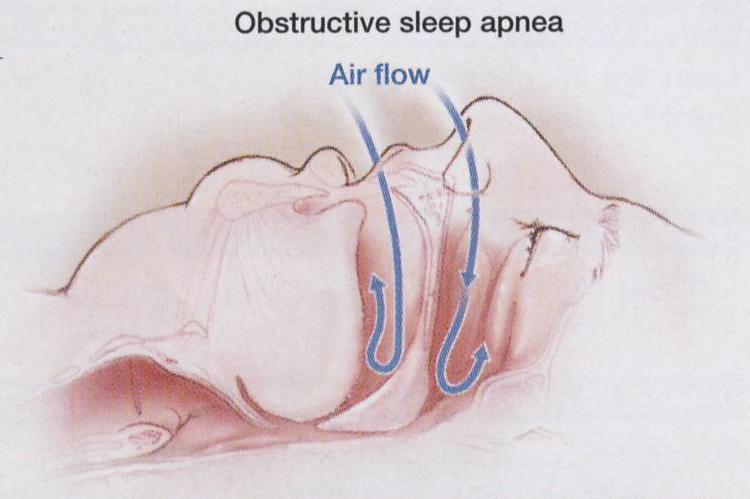
I want to start off by saying that I would like you to really look at my title again. It says Obstructive Sleep Apnea. This is very important since there are not only obstructive apneas, but central apneas, mixed apneas, and a slew of other respiratory events at night. The pictures below are reflecting some degree of obstruction. I thought they were well done, so I scanned them in.

You can see in the first one that normal breathing while on the back (when gravity is most likely to pull your tongue and uvula and soft palate into the way) involves breathing some through your mouth and some through your nose. Some people are obligate nose breathers and some are obligate mouth breathers.


This picture below shows breathing obstruction present in OSA (Obstructive Sleep Apnea). Now, obstruction of your mouth by itself is okay; most of us naturally close our mouths and breath through our nose only at night anyway. And obstruction of your nose is okay too, such as when we have a cold. Obstruction of the nose is only a problem with many people when it's hard for them to switch to mouth breathing. But below is complete obstruction the final common pathway, where the nose and throat join up to head down the trachea to supply the brain, heart... body with oxygen and get rid of carbon dioxide.


This is a simpler version of the same thing. Here we see partial obstruction, involving the back of the throat, but air is still getting by through the the nose.


In this drawing, again, as above, we have complete obstruction of the entire airway... the patient is in essence, being choked. 
That really is the accurate way of describing what is happening. In real life, while conscious, people wouldn't choke themselves or allow themselves to be choked as long as they do while they're asleep if they have obstructive sleep apnea. But, since you're asleep, and have to sleep at least a little to live, and eventually, you will literally knock yourself out and be choked, unable to defend yourself against the demands of your own body.


Prevalence of Obstructive Sleep Apnea (OSA) How common is it?
- 42 Million American adults
- 1 in 5 have mild OSA
- 1 in 15 have moderate to severe OSA
- 25% of men the middle-aged work force suffer from OSA
- 9% of middle-aged women suffer from OSA
- About 20 million have asthma in America, and 23 million have diabetes (as of 2007) which makes OSA almost as common as both all asthmatics and diabetics combined in America
- 75% of severe cases remain undiagnosed as of 2008

Are you one of these folks?


Untreated sleep apnea has many common clinical signs & subjective symptoms:

- Lack of energy
- Waking feeling unrefreshed in the morning
- Frequent nocturnal urination
- Excessive daytime sleepiness
- Gastroesophageal reflux (GERD)
- Morning headaches
- Nighttime gasping, choking, coughing
- Snoring
- Decreased concentration
- Accidental naps during the day
Etc.

Now let's talk about the link between sleep apnea and other medical comorbidities. And, actually, they should be more concerning because of the long term relationship between these other comorbidities and their potential dire consequences.

Hypertension:
- Sleep apnea is an independent risk factor for hypertension, separate from obesity, family history, diet...
- 30-80% of patients with hypertension have sleep apnea
- 43% of patients with mild OSA and 49% of patients with severe OSA have hypertension
- Patients with hypertension resistant to medications are likely to have some improvements with treatment of comorbid sleep apnea

Diabetes:
- Half of patients with Type 2 Diabetes have sleep apnea
- OSA may actually turn out to be a cause for some people's diabetes
- 30% of patient who present to a sleep clinic have impaired glucose intolerance
- Detecting mild apnea may actually help predict (as a risk) pre-diabetes

Obesity:
- 86% of people with obesity & diabetes together have the additional burden of sleep apnea

- OSA can be an independent contributor to obesity by inducing insulin resistance


Below, I made my own Venn Diagram of overlapping comorbid conditions, expanding on the Hypertension-Diabetes-Obesity diagram above... I included some other well-known links as well. Obviously, as Neurologist, you know I care about stroke a lot, which is a growing concern on linkage.

Stroke:
- 65% of stroke patients have apnea
- Sleep apnea is an independent risk factor for stroke

Cardiovascular:
- Half of people with heart failure have apnea (often the central apnea)
- Untreated sleep apnea causes remodeling of the heart, leading to an increased risk of developing atrial fibrillation and a more difficult time treating it successfully
- Mild/moderate apnea is present in over half of heart attack patients

Depression & Anxiety
-Not only are patients with untreated apnea more likely to have both and more difficult to treat versions of both, they are more likely to have difficult-to-treat chronic pain and more difficult-to-treat psychiatric disorders as well. These in themselves feed into the other comorbidities.


You thought I was finished?

No, there are other things too.

Traffic Accidents:
- 15-fold increase of being involved in a traffic accident
- If we found and treated all sleep apnea patients, it's estimated we'd save 980 lives each year and $11.1 billion dollars in collision costs.

Overall death:
- Severe sleep apnea raises the death risk 46%
- Apnea is associated with a 3-fold increase in death
- Moderate to severe OSA is independently associated with death.


Again, apnea is essentially short periods of choking all during the night. Hold your breath for 10 seconds. It seems like such a simple thing, but if your really think about it, if I choked you of air all day long intermittently for 10 seconds at a time...
A) You would fight me off 
and
B) You'd be miserable

So why would you let it happen at night?