Showing posts with label Multiple Sclerosis. Show all posts

Monday, October 7, 2013

Vitamin D and Multiple Sclerosis: Low serum levels = MORE disease and MORE severity of disease


This recent abstract at a large Multiple Sclerosis meeting confirms what neurologists already know, but underlines it quite well: There is something going on between Vitamin D levels and both the diagnosis of Multiple Sclerosis and the progression of it. This study just helped support the concern that lower levels in the bloodstream, versus higher levels, meant more disability from the disease.

This study essentially compared normal levels of Vitamin D versus sub-par levels in the blood. All the normal level patients did better than those that ran low.

I have all my patients with MS take Vitamin D supplements of 4000 I.U. daily at a minimum and many at 10,000 I.U. daily. I would rather patients be on the higher end of the spectrum.

I starred my favorite line below, toward the end. 

I saw the original abstract which is quite tedious and boring-looking. Here's the more digestible story summary in greater detail below:
--------------------------------------------------------------------------------------------

COPENHAGEN -- Higher levels of 25-hydroxyvitamin D correlate with less Multiple Sclerosis disease activity and progression, researchers reported .
Every 50 nmol/L increment in average serum 25-hydroxyvitamin D levels observed at baseline translated into a 57% lower rate of new active multiple sclerosis-defining lesions (P=0.0009), reported Alberto Ascherio, MD, MPH, professor of medicine at Brigham & Women's Hospital and Harvard Medical School.
In his oral platform presentation at the annual meeting of theEuropean Committee for Treatment and Research in Multiple Sclerosis, Ascherio also found that higher baseline differences in 25-hydroxyvitamin D levels were associated with:
  • A 57% lower relapse rate (P=0.03).
  • A 25% lower increase in T2 lesion volume (P=0.00004).
  • A 0.41% lower yearly loss in brain volume (P=0.07) from 12 to 60 months.
  • Fewer active lesions at MRI (Hazard ratio 0.73, P=0.002).
  • A lower increase in T2 lesion volume (difference = - 9% per year, P=0.008).
  • A lower rate of brain loss (0.32% versus 0.66% per year, P=0.005)
  • Lower disability demonstrated by a -.17-point reduction in the Expanded Disability Status Scale score (P=0.004) during the subsequent 4 years.
Ascherio said he was unable to determine from his dataset if the lower levels of 25-hydroxyvitamin D were due to the person's lifestyle or to the disease, which influences lifestyle choice.
However, the findings were compelling to session moderator Eva Havrdova, MD, professor of neurology at Charles University in Prague. She told MedPage Today, "The 'normal' level of Vitamin D he was talking about in his study is what is needed to prevent rickets. It is not a very high level of Vitamin D. I think supplements of Vitamin D to increase Vitamin D levels up to 100 nmol/L level would be worthwhile, and maybe you would see improvements in the health status of our patients."
For his study, Ascherio and colleagues scrutinized the patient records of those who participated in the BENEFIT study, which compared treating people with clinically isolated syndrome (CIS) either early in the course of the trial or later on. As part of the trial, researchers collected data of baseline 25-hydroxyvitamin D, a marker of vitamin D levels. Levels of 25-hydroxyvitamin D were tracked for a year. Ascherio and his research team then tracked how levels of vitamin D correlated with multiple sclerosis outcomes.
The comparisons in the study were made between those patients whose yearly average level of 25-hydroxyvitamin D was 50 nmol/L or greater and those with lower levels of 25-hydroxyvitamin D. The researchers also broke down the participants in quintiles to further elucidate how differences in 25-hydroxyvitamin D affected patient outcomes. The analyses were adjusted for sex, age, initial randomization group -- treatment with interferon beta-1b or placebo, baseline T2 lesion scores and type of CIS.
The study population included 251 patients with 25-hydroxyvitamin D levels below 50 nmol/L, and 213 patients with multiple sclerosis who had a higher level of 25-hydroxyvitamin D. The median level for the low 25-hydroxyvitamin D group was 39 nmol/L; the median for the higher 25-hydroxyvitamin D group was 60 nmol/L.
The subjects in the study were about 31 years of age; more than 70% were women. At baseline, the low 25-hydroxyvitamin D level patients had a median of 20 T2 lesions compared with 15 lesions in those with higher levels of 25-hydroxyvitamin D.
**********************************************************************************
"Higher serum 25-hydroxyvitamin D levels early in the course of multiple sclerosis robustly predicted a lower degree of multiple sclerosis activity, MRI lesion load, brain atrophy, and clinical progression over 5 years," Ascherio said.
**********************************************************************************
The study, however, leaves many unanswered questions, he said. "Further investigations are needed to determine whether results apply to patients of different races, those later in the disease course, those with progressive multiple sclerosis, or to the effects of 25-hydroxyvitamin D in combination with other drugs aside from interferon beta-1b," he added.

In Summary: Treat Multiple Sclerosis or MS-like isolated presentations early and have a better outcome

I will summarize the recent abstract (NOT a formal published study yet, but presented at one of the largest yearly MS meetings in the world), almost 2000 patient charts were reviewed and followed for 3 years on average. These were all patients with Clinically Isolated Syndrome (CIS) which is essentially, a first-time MS-like demyelinating event somewhere in the brain or spinal cord. But it is technically NOT Multiple Sclerosis... yet.

Traditionally these patient were not treated and followed to see if it happened again, and if it did, ONLY then were they treated as MS patients would be.

This study confirmed what many of us have already been shouting: If you suspect a hint of demyelination, treat early and treat thoroughly. Time is brain/spinal cord, and the earlier you treat AND more cvonsistently you treat, the better the LONG TERM outcome is. This is true for CIS as well as definitive MS. No one has been arguing the MS side of that truth, but this study just helped confirm the CIS side as well.

I would make this argument, and I believe many neurologists already are as well: We should not call it Clinically Isolated Syndrome (CIS).... but something like Initial Multiple Sclerosis (IMS) or Evolving Multiple Sclerosis (EMS) or something (for some reason we love acronyms in medicine). At least this would help deter clinicians from waiting to treat it aggressively.

Below is an expanded summary of the article:
----------------------------------------------------------------------------------------


COPENHAGEN – Patients who received early and consistent disease modifying treatment at the first signs of multiple sclerosis – often called clinically isolated syndrome (CIS) – appeared to have a slower progression to disability than patients who were treated mainly for additional MS exacerbations, researchers reported here.
Over a 12-month period, patients treated 50% to 80% of the time following the first CIS event reduced their risk of progression -- as measured by the Expanded Disability Status Scale score -- by 45% compared with patients who received disease-modifying treatments less than 50% of the time or not at all (95% CI 0.39-0.79, P=0.001), and patients treated for more than 80% of the time following diagnosis reduced their risk of disability progression by 68% (95% CI 0.22-0.49, P<0.001), said Vilija Jokubaitis. PhD, medical research scientist, University of Melbourne. 
"What was very interesting about this finding was that the patients who appeared to be worse after their CIS and MRI evaluation and who were treated early, did better than patients whose treatment was delayed," she said in her oral Young Investigators report at the annual meeting of the European Association for the Treatment and Research In Multiple Sclerosis.
About three-fourths of these patients were classified on the basis of T2 lesion enhancement as having relapsing-remitting multiple sclerosis at first treatment. Jokubaitis suggested that because their initial examinations looked worse, the patients were treated more aggressively, and that appeared to have long-term benefits in preventing progression.
"Study after study has shown that early treatment with disease-modifying drugs benefits patients with CIS," said Margaret Burnett, MD, assistant clinical professor of neurology and pathology at the University of Southern California in Los Angeles.
"It kills me that some places still are not treating CIS," she said. "These findings presented here are corroborating evidence that we should be treating CIS and we should make every effort to provide continuous treatment."
In the study, Jokubaitis and colleagues reviewed data involving 1,989 patients for whom complete records were available. The patients had a combined 6,724 years of follow-up with a median follow-up of 3 years per patient – ranging from 9 months to 9.9 years.
Of those patients, 1,339 were treated with disease-modifying agents, either interferon-based products or glatiramer acetate (Copaxone). The researchers included 307 patients who had sustained disability progression over 12 months.
The goal of the study was to determine predictors of progression, and the investigators found that advancing age was a weak prognosticator of disability progression – a 17% increased risk per decade (P=0.006). They also found that pyramidal system dysfunction was a strong predictor of disability progression – with higher imaging pathology translating to a 46% increased risk of disease progression (P=0.008).
Jokubaitis acknowledged that teasing out how treatment affected outcomes was confounded by the fact that sicker patients at diagnosis were more likely to be treated early and consistently, which helped them avoid disease progression.
She and her colleagues did scrutinize the different disease-modifying agents used in the study, but found all of them were successful in delaying progression and none appeared significantly better than the other, although treatment with glatiramer acetate approached significance compared with interferon-beta 1a intramuscular injection (P=0.052) in an ad-hoc analysis.
"Cumulative disease-modifying treatment duration significantly delays progression of multiple sclerosis," Jokubaitis said.

Wednesday, March 7, 2012

Some Newer Data on Multiple Sclerosis Management (Interferon, Tysabri, Vitamin D, Pain)


The below is a review of select data presented at the recent
5th Joint Triennial Congress of the European and Americas Committees for Treatment and Research in Multiple Sclerosis... also known as ECTRIMS.

And so I wanted to share it with you because I thought it had some fantastic nuggets of good information for my patients with MS.

As you look this over, be patient with me. No one likes unwieldy graphs, but these are pretty straight forward and they are summarized as well. But I think that if you or your loved one have MS, I believe it's reasonable for me to expect you to gather the patience to wade through some graphs created for you.

ECTRIMS this year had a number of presentations looking at how to optimize our currently existing disease-modifying therapies, treatments for acute relapses, and symptom management. Although a lot of attention is paid towards the future therapies, I think maximizing what we have available to us today is crucial.


The REFLEX trial is a study of two administration schedules of interferon β-1a at 44 μg (commonly known as Avonex or Rebif, although they are meant to represent any of the interferons). This is a clinically isolated syndrome trial (just one attack of demyelination, before the actual official diagnosis of MS), so a trial of this drug after the first attack of demyelinating disease, and this is a three-arm (3 separate groups) study of 44 μg given subcutaneously three times a week versus only once a week versus placebo (no active medication) injections.

The main purpose of this is really to establish the efficacy in clinically isolated syndrome (to see if works at helping prevent a one-time event from actually turning into MS).

A secondary purpose of this trial is to demonstrate the efficacy of three-times-a-week interferon—the high-dose, high-frequency strategy of interferon use—over a less frequently dosed schedule (if more of the medication within reason, better).


The outcomes of this looked at the development of MS by the McDonald criteria, which has become the standard way of looking at diagnostic certainty for multiple sclerosis (especially for all research studies to make the diagnosis is uniform across the planet). I should add that they used the McDonald 2005 criteria, as opposed to the more recently developed 2010 criteria; this trial was run well before that most recent criteria was produced (although the new criteria isn't too significantly different).

The primary outcome data showed that with NO TREATMENT (placebo medication) the median time to convert to McDonald MS was 97 days (about 3 months).

On interferon 44 μg given once a week, it was 182 days (half a year).

And, on interferon β[-1a] 44 μg given three times a week, it was 310 days (2 months shy of a year).

This shows a reduction in the risk of conversion to MS of 31% in the weekly interferon dose (a third less likely) and 51% in the three-times-a-week interferon dose (half as likely).

This outcome is important for a couple of reasons. One, it further provides confirmatory evidence that interferon β-1a is a viable treatment strategy after a first attack, or the CIS, versus placebo. I think it also provides support for the three-times-a-week dosing schedule versus weekly interferon [β]-1a.


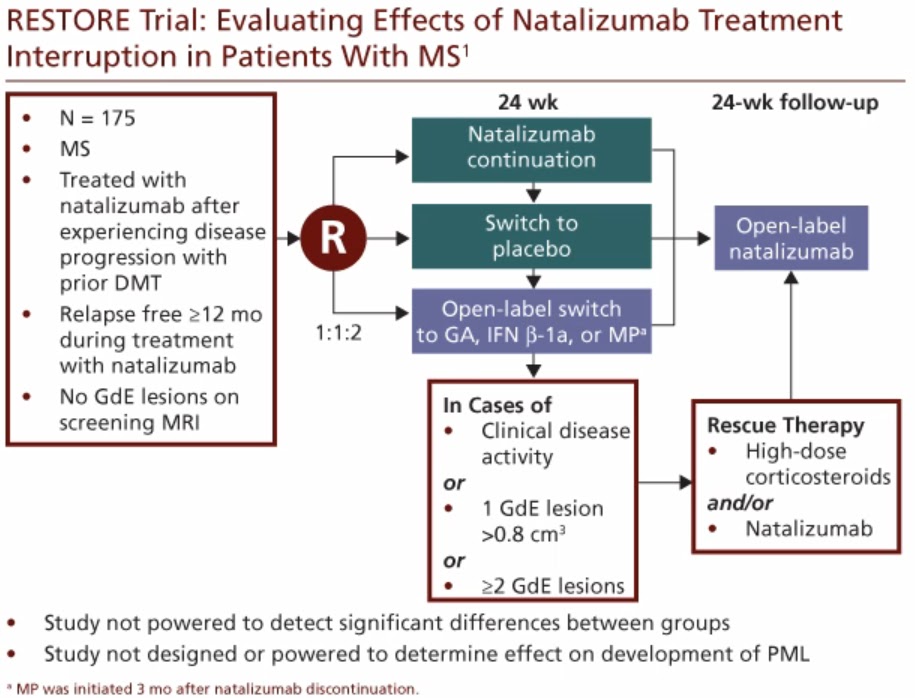
The RESTORE trial was seeking to evaluate the effect of natalizumab (Tysabri) treatment interruption on the clinical course of patients with MS (In other words, what happens if we stop Tysabri due to health concerns?)

In short, there has been a lot of consternation in our field in the past couple of years about how long to keep patients on natalizumab, what with the recognition of the increasing risk of the awful PML with increasing duration of exposure to the drug (The longer you're on the medication, the more likely you are to get PML). This trial was done specifically to look at what are the risks of discontinuation of natalizumab to sort of counterbalance the concerns about the risks inherent in continuing a patient on natalizumab (getting PML as a risk of continuing versus return of MS by stopping).

So this trial looked at patients who'd been on natalizumab and have it discontinued, followed by placebo infusions (fake medication), and then a series of open-label rescue therapies (any interferon or other real medication used to treat MS) to see if disease activity recurred. Disease activity here was described as both clinical activity—changes in EDSS [EDSS: Expanded Disability Status Scale] scores—or MRI disease activity, consisting of new gadolinium (contrast)-enhancing lesions.


In brief, what this study ultimately showed is that stopping natalizumab confers an increased risk of the return of disease activity in multiple sclerosis. There were a substantial number of relapses and an even more substantial number of MRIs showing the resurgence of disease activity in the weeks and months that followed natalizumab cessation. In particular, the highest rate of recurrence of disease activity seemed to appear at around week 12, after natalizumab was discontinued.

This provides some supportive data to the notion that stopping natalizumab therapy brings about a somewhat riskier period of time for MS patients when disease activity may return.

It does not answer the question as to how to treat these patients after natalizumab is stopped, nor does it provide specific guidance in regards to which patients should be maintained on natalizumab for a longer period of time. But I do think it provides some supportive evidence to know that patients in whom natalizumab has been stopped, for whatever reason, need to be observed closely and likely treated promptly with other disease-modifying therapies (Avonex, Rebif, Betaseron, Copaxone, Gilenya, etc...) to prevent the recurrence of their MS.

The vitamin D story in multiple sclerosis has evolved rapidly over the last several years. It has long been recognized that there is a latitudinal gradient to the incidence of MS with higher incidence seen further from the equator.


The role of direct sunlight and, therefore, natural generation of vitamin D being more prevalent near the equator has been one hypothesis for this difference in the incidence of MS.
Subsequently, epidemiologic studies of patients have shown that there may be a correlation between chronically low vitamin D states and the development of multiple sclerosis in otherwise more homogenous populations. Due to this, a lot of attention has been turned to vitamin D to see whether it, in fact, correlates with the development of MS and the severity of MS, and whether, perhaps, treating with supplements of vitamin D can be disease modifying.


Studies presented at ECTRIMS looked at the effects of endogenous and supplemental vitamin D in patients with MS. And they found that, for every 10-ng/mL increase in vitamin D levels, there is a significant reduction in the risk of new gadolinium-enhancing or T2 lesions (32% decreased risk and 15% decreased risk for these different "flavors" of MRI imaging).

Supplemental vitamin D3 decreased gadolinium-enhancing lesions. I think this study continues to further the notion that there is a meaningful relationship between vitamin D levels and MS disease outcomes. And certainly provides some tantalizing evidence that supplementing vitamin D may allow us another angle to change the disease course. There is going to be larger and ongoing studies of vitamin D supplementation, trying to evaluate this in a larger population with clinical outcomes. That work is ongoing.


Turning to symptom management in multiple sclerosis, pain is a very commonly reported symptom of MS, and many studies have shown that it has significant impacts on quality of life in people with multiple sclerosis.
This study looked at the use of duloxetine (Cymbalta) in the treatment of central neuropathic pain in MS patients. And the study was positive and showed a greater improvement in the pain index scores for duloxetine versus placebo-assigned patients, although there was a significant placebo effect on pain. But duloxetine did have better outcomes in a statistically significant way than placebo at controlling central neuropathic pain in the patients studied here.
This trial provides information that duloxetine and this class of medicines may very well have a role for pain management in multiple sclerosis. As we have seen, other comorbidities and related symptoms in MS that are very common include depression and anxiety. And, although these things weren't studied as outcomes in this trial, the utilization of a medicine that may also help to treat depression and anxiety, as well as pain symptoms, may be a very useful strategy in a number of MS patients with several MS-related quality-of-life symptoms.


Before we fully turn our attention to the emerging therapies on the horizon, it's important to think about maximizing the efficacy and outcomes of our currently existing therapies across the needs of MS patients.
We also have to carefully balance the benefit-to-risk ratio of our medicines in the long-term for MS patients. A lot of attention has been turned to the risks of our medicines, such as the risk of PML with natalizumab. The trial we discussed talks a bit about the other side of that risk equation: What are the risks inherent in MS when a treatment like natalizumab (Tysabri) is discontinued? Showing there that stopping natalizumab therapy does seem to result in a high rate of recurrence within the first 12 weeks after the treatment is stopped.
And the vitamin D story continues to evolve with data now suggesting that not only are lower levels of vitamin D related to higher levels of MS disease activity, as shown on MRI, but, in fact, treating with supplementary vitamin D may exert a significant protective effect in this regard.
Finally, looking at symptom management, duloxetine (Cymbalta) appears to be a viable management option to treat central pain syndromes that are so often seen in multiple sclerosis.

Thursday, August 11, 2011

New Multiple Sclerosis Genes Found:

Breakthrough multiple sclerosis DNA study could lead to new treatments

By Ryan Jaslow
 

(Credit: istockphoto.com)

(CBS) New drugs for multiple sclerosis could be on the way, now that a landmark study has given scientists an unprecedented glimpse into the disease's genetic underpinnings.
In the largest gene study of multiple sclerosis ever, scientists compared DNA from nearly 10,000 people with multiple MS, with DNA from more than 17,000 unrelated, healthy individuals.

The scientist successfully confirmed 23 previously known genetic links and identified 29 new ones, in addition to five strongly suspected genes that contribute to MS.
"We have moved from three [genes linked] in 2007 to 57 now," study co-author Dr. Alastair Compston, professor of neurology at the University of Cambridge, U.K., told Web MD.
Many of these genes play pivotal roles in immune system function, according to Compston. Specifically, the genes are linked to T-cells, which mount the body's immune response, and interleukins, which help different types of immune cells interact with one another.
"They tell a remarkably coherent story because 80 percent of them are all genes which drive the body's immune response." Compston said.
What does that mean for MS? Experts had previously debated whether MS is a degenerative disease that causes immune system inflammation but this research suggests it's the other way around, according to Compston - and that can guide future treatments.
"It is now clear that multiple sclerosis is primarily an immunological disease," Compston told Reuters. "This is the way to nail this disease and get on top of it."
The study was published in the August 11 issue of Nature. Another study, published in the journal PLoS Genetics, found that many genes linked to MS are also found in other autoimmune diseases, like Crohn's disease, psoriasis, lupus, and Type 1 diabetes. That means if doctors can successfully treat one of these disease, they might uncover how to treat another.
"These findings will help focus future research to find new ways to intervene in the course of MS and other diseases," Dr. David Hafler, professor of neurology and immunobiology at Yale University, and an author on both papers, said in a written statement.


About 400,000 Americans have MS, while another 200 diagnosed each week, according to the National Multiple Sclerosis Society. Most people are diagnosed with the disease between ages 20 and 50, although it can also appear in young children and the elderly. The disease attacks the central nervous system, causing symptoms that include fatigue, memory loss, and problems with balance and muscle coordination.

Tuesday, May 31, 2011

Solu-Medrol Treatment for Multiple Sclerosis: Side Effects and Tips

If you look up the potential side effects of IV Solu-Medrol treatments for Multiple Sclerosis (or the other numerous potential reasons one might might receive this treatment), you will find a very long and somewhat scary list. That's not what this entry is only about (I'm not going to list here what you can search online for). This entry is about trying to decrease the chance of developing many of those side effects and try to make receiving this treatment as comfortable as possible. 
By the way, after you receive the IV corticosteroids, we usually give a short by-mouth taper off of steroids so your body isn't "shocked" by the sudden cessation of some medication it was just getting used to. Some of the residual symptoms one experiences can last during the by-mouth dosing time but often slowly improve within about a week after you stop all the corticosteroids.

*** After reading over this for me, my nurse pointed out something very important from her experience working specifically with MS patients receiving Solu-Medrol. Solu-Medrol is NOT a substitute for your regular MS medications. Therefore you should not think that if you forget to refill it or can't use it while on a vacation, that Solu-Medrol is an adequate "backup plan." It is not. That sort of thinking is a good way to get you into a wheelchair quicker than someone else who doesn't think that way. You should also never stop your regular MS medications while receiving this Solu-Medrol treatment, unless your doctor wants you to for some specific reason. ***

 Before Infusion Starts
·         Be Well-Hydrated: Drink lots of fluids before you go for your infusion. Being well-hydrated makes your veins larger and easier to find, which makes insertion of the IV line a breeze.
·         Protect Your Gut: Solu-Medrol causes gastritis and heartburn if administered on an empty stomach. It is wise to eat a large meal before your treatment. Treat yourself to your favorite (healthy) foods and fill up -– food will taste strange for a couple hours after your treatment, anyway. 

·         Request Paper Tape: You may ask that paper tape be used to secure the IV line, at least on the first layer next to the skin, which can then be covered with standard tape or a bandage for protection. Solu-Medrol makes your skin very fragile, especially around the area where the IV line is inserted. Paper tape will come off much easier when it is time to remove the IV.
·         Choose Your Hand: Decide ahead of time which hand you prefer be used for the IV. The line may be kept in place for up to five days, and it can be annoying to have it in the hand that you use for holding a book or using a computer mouse. Of course, the placement may be decided for you when the nurse looks for an “easier” vein to use, but you can state your preferences if this is a concern for you.
During Infusion
·         Have Mints Handy: During the infusion, you might experience a metallic taste in your mouth. It is helpful to have strong mints or gum to use, as water doesn’t help and other beverages or foods taste terrible.
·         Try to Relax: Bring your music or a book on tape to listen to during the infusion. Books and magazines are also good, but there is always a chance that the IV line will make these awkward to handle. Try some deep breathing exercises –- count each breath up to ten, then count back down to one.
·         Slow Down: If your face starts feeling hot or if your heart starts beating fast, ask the nurse to slow down the rate at which the medicine is being infused.
·         Flush With Saline: Make sure that the nurse flushes your line with saline after each infusion. Rarely nurses may not think much of this, but it may help decrease the bruising and thinning of the skin in that arm.
Following Infusion
·         Eat Comfort Food: As mentioned, food will taste strange for a couple hours after treatment, so bland is good. However, you will want to avoid anything greasy, as this could aggravate heartburn. Also, limit sweets and things with high sugar content, as Solu-Medrol will increase blood sugar levels.
·         Avoid Salty Foods: Solu-Medrol causes water retention. This can lead to feeling bloated all over, as well as to swollen feet and ankles. Avoid salty foods and drink lots of water to minimize this effect, which should disappear within a week of the last treatment.
·         Be Quiet: Solu-Medrol makes most people feel anxious and agitated. During this time, it is best to stay home and be calm and quiet. Do not try to go to work –- you will not be productive and your interactions with your co-workers may come back to haunt you.
·         Don’t Drive: You may have a hard time concentrating, may be nervous, or your perception may be “off.” Even if you think it will be okay to drive, it is a good idea to have someone drive you home after each infusion. Leave the worries about traffic and the quick decision-making needed for driving to someone else.
·         Troubleshoot Insomnia: Solu-Medrol causes insomnia, which some people call a “welcome” side effect, as they end up cleaning house, balancing checkbooks and answering e-mails. However, you need your rest during this time –- this treatment is putting a huge strain on your body which can actually make things worse in some people. Try different techniques to help you sleep, but don’t hesitate to ask your doctor for medicine for this purpose. A little temporary Klonapin for this is rarely an issue, but many times a little over-the-counter benadryl before bed or tylenol PM is just as effective, and less expensive.
Other Less Common Tips
·         Use Herbs with Caution: Solu-Medrol side effects may be exacerbated by some herbs, including aloe, Asian ginseng, bayberry and licorice.
·         Protect Your IV Line: If you need an MRI during this time, do not allow the MRI technicians to use your IV line to administer the gadolinium. While this saves them time, the gadolinium is caustic and could cause your vein to collapse, meaning the IV line will have to be reinserted for your next Solu-Medrol treatment.
·         Avoid Infections: Steroids greatly reduce your immune system’s ability to fight infection. Avoid any contact with people who have symptoms of colds or other viruses. If you have not had chickenpox, it is extremely important to avoid people with chickenpox or shingles. If you had chickenpox in the past, you will be more vulnerable during your treatment to developing shingles. Notify your doctor immediately if you develop a fever, chills, respiratory symptoms or a rash.
·         Avoid Vaccinations: It is a good idea to avoid all vaccinations during this time. It is especially important to avoid getting the smallpox vaccine (this probably won’t inconvenience anyone too much). I would also not get the flu shot at this time, but you should especially avoid the flu vaccine that is administered as a nasal spray, as that is a live vaccine. (Actually, if you have MS, you should really never get a live vaccine unless specifically discussed with your doctor)

HOPE THIS HELPS. If you have other pointers that you think should be added, or modifications of this... please email them in to me. I will not mention a thank you for your addition if you ask me not to.